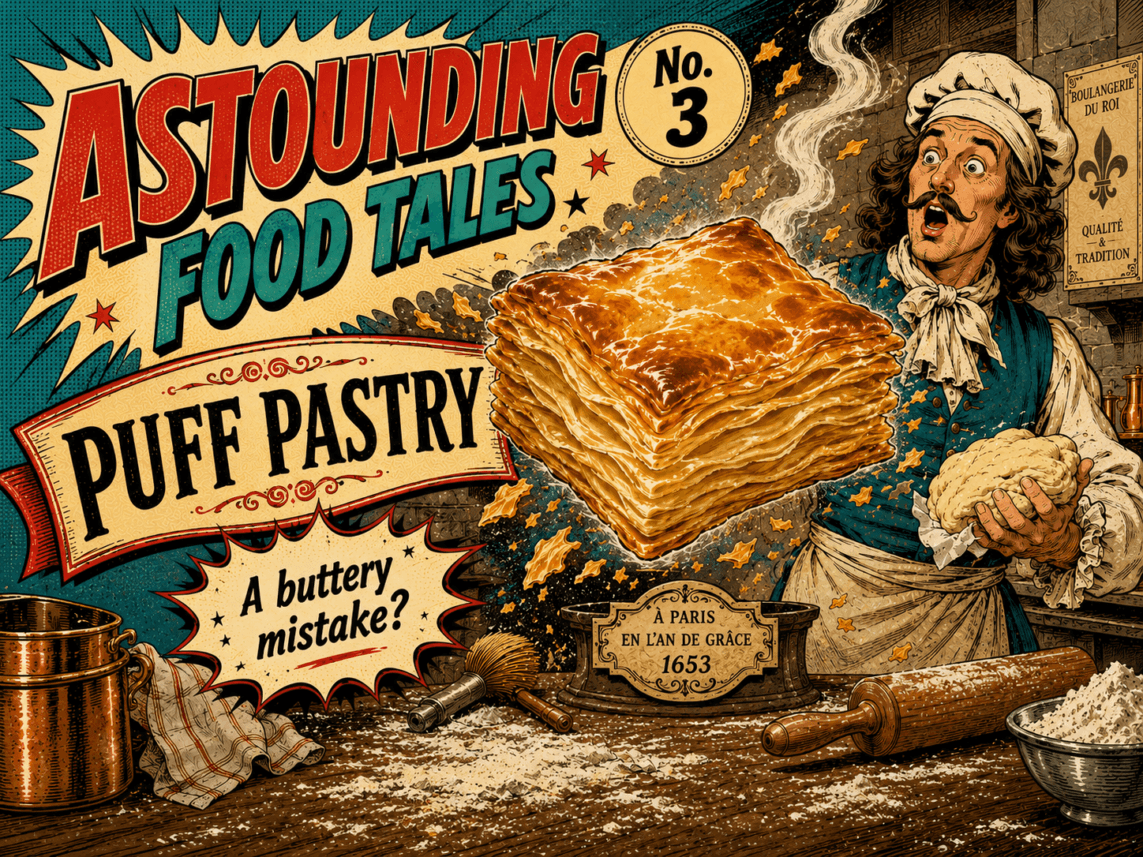
Food is about cooking and eating, obviously. But it’s also about stories, memories, history and expectations.
Those things matter because they shape how people understand value, experience and mealtimes.
Our Astounding Food Tales series looks at the often wonderfully bizarre origins of foods we now take for granted. Some of the stories are true. Some are disputed, and some might possibly be nonsense wearing a very convincing hat.
But that’s part of the point.
Food rarely arrives on the plate as just a product. It arrives with associations: place, culture, nostalgia, status, comfort, ritual and sometimes myth. These things influence what people choose, what they remember and what they feel something is worth.
At MYA, we understand that hospitality is not only operational. It’s also experiential. The best foodservice strategies are built around flow, quality, efficiency and compliance, yes, but they should never neglect narrative and meaning.
Because a meal can feed someone.
A story can bring them back.
Which brings us to puff pastry.
One of my favourite food history stories involves a mistake that may never have happened.
The legend says puff pastry was invented in a French kitchen in the 1600s by Claude Gelée, later known as the painter Claude Lorrain.
The story goes that he was trying to make a simple buttery loaf for his sick father, whose diet was supposedly restricted to flour, water and butter. Instead of mixing the butter into the dough, he wrapped it inside, then rolled and folded the dough repeatedly.
His master thought it would be a disaster. The butter would melt. The dough would collapse. The kitchen would probably smell of failure and expensive dairy.
But they baked it anyway.
Instead of falling apart, the pastry rose into hundreds of delicate, flaky layers.
A perfect origin story.
Unfortunately, probably nonsense.
Food historians are sceptical. There is little reliable evidence that Claude Lorrain invented puff pastry, and similar techniques involving layered dough and fat were already circulating in Europe before the legend properly took hold. A modern-style recipe appears in Spain in the early 1600s, with British recipes following later in the century.
The real story is less theatrical, but more useful.
Puff pastry was probably not born of a single dazzling accident. It was refined over time by many cooks, bakers and kitchens, each improving the process layer by layer.
That is the genuinely interesting part.
Puff pastry works because butter and dough are folded into thin layers. In the oven, steam pushes those layers apart. No grand revelation required. Just technique, patience and heat.
We like innovation stories with a single genius, one mistake, one thunderclap moment.
But most real innovation is quieter than that.
It is repeated effort. Small improvements. Borrowed ideas. Better methods.
Layer upon layer.
Which, for puff pastry, feels almost suspiciously appropriate.
At MYA, we see the same principle in foodservice design. The best results rarely come from one grand gesture. They come from understanding the detail, refining the process, and building something that works beautifully under pressure.
If you are developing a food offering, menu concept, or hospitality space that requires more than surface-level thinking, we would be happy to talk.