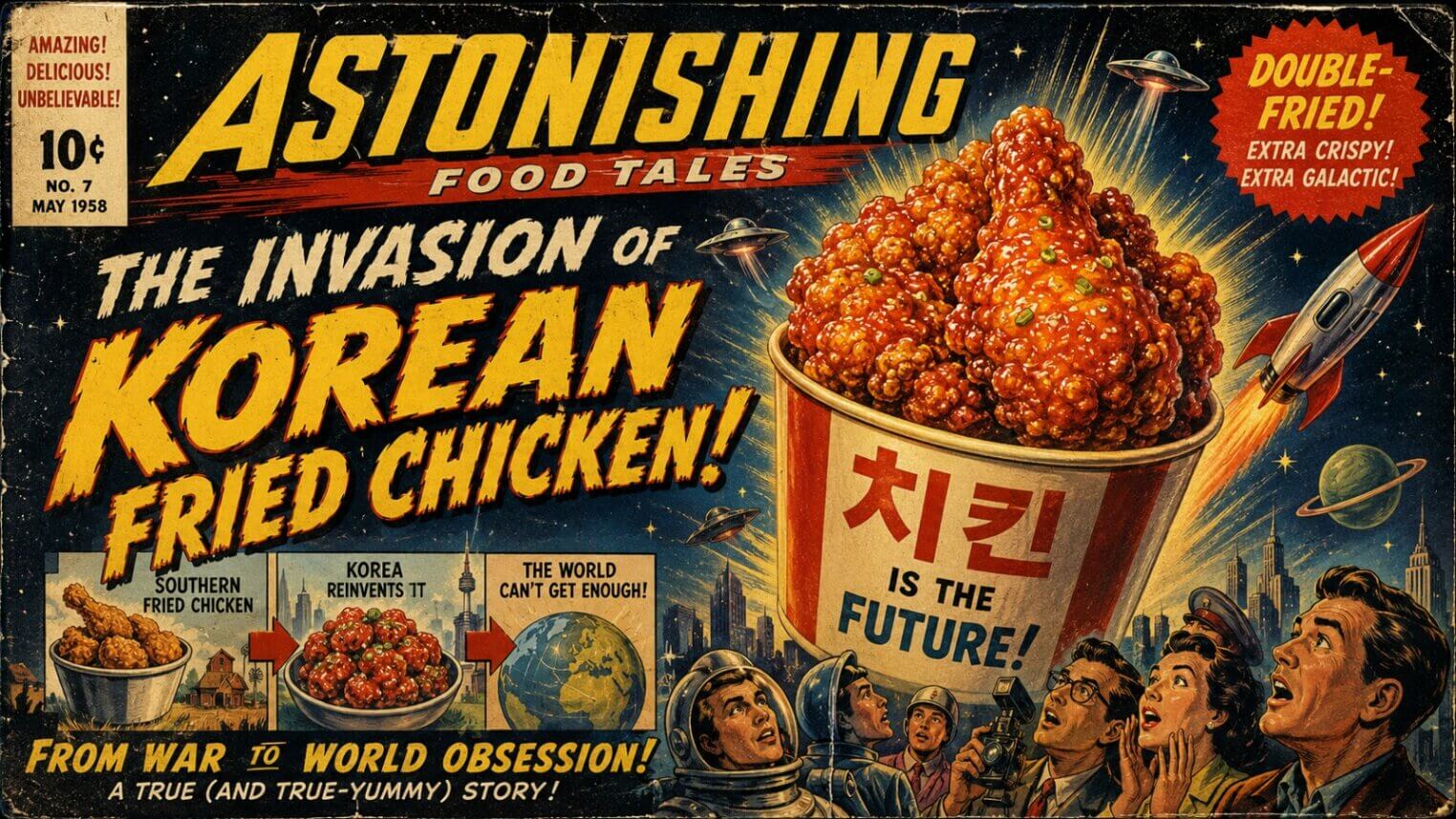
Most people assume Korean fried chicken is simply fried chicken with Korean sauce.
It’s not.
Its story is tied to the Korean War, American military influence, post-war economic change and South Korea’s rapid industrialisation. Before the 1950s, deep-fried chicken was not a major part of Korean food culture. Cooking oil was expensive, chicken was more valuable for eggs, and traditional Korean cooking leaned more towards steaming, grilling, boiling and fermentation.
Then American troops arrived during the Korean War, bringing with them Southern-style fried chicken, mass-produced oils, processed seasonings and American dining habits.
But Korea didn’t simply copy the idea.
They reinvented it.
By the 1970s and 1980s, as South Korea’s economy transformed, fried chicken chains began to emerge. Korean fried chicken developed its own identity through lighter coatings, double-frying for extraordinary crispness, and bold flavours such as soy-garlic and gochujang glazes.
It also became social food. Late-night food. Food to share over beer. Chimaek, the now-famous combination of chicken and beer, turned fried chicken into part of a wider cultural ritual.
And that influence is travelling back.
American restaurants increasingly use Korean frying techniques, Korean sauces and double-fried textures. So, the journey looks something like this:
Southern American fried chicken → Korea → Korean reinvention → global trend → back into America.
That’s often how food culture works. Not through immaculate invention in a sealed room somewhere, but through collision, adaptation, borrowing, improvement and exchange.
For hospitality and food strategy, that matters.
The most successful food ideas aren’t static. They move. They absorb. They respond to economics, migration, technology, taste, identity and social behaviour.
Korean fried chicken isn’t only a menu item.
It’s a reminder that food carries history, culture and commercial intelligence in every bite.
Preferably a very crispy one.