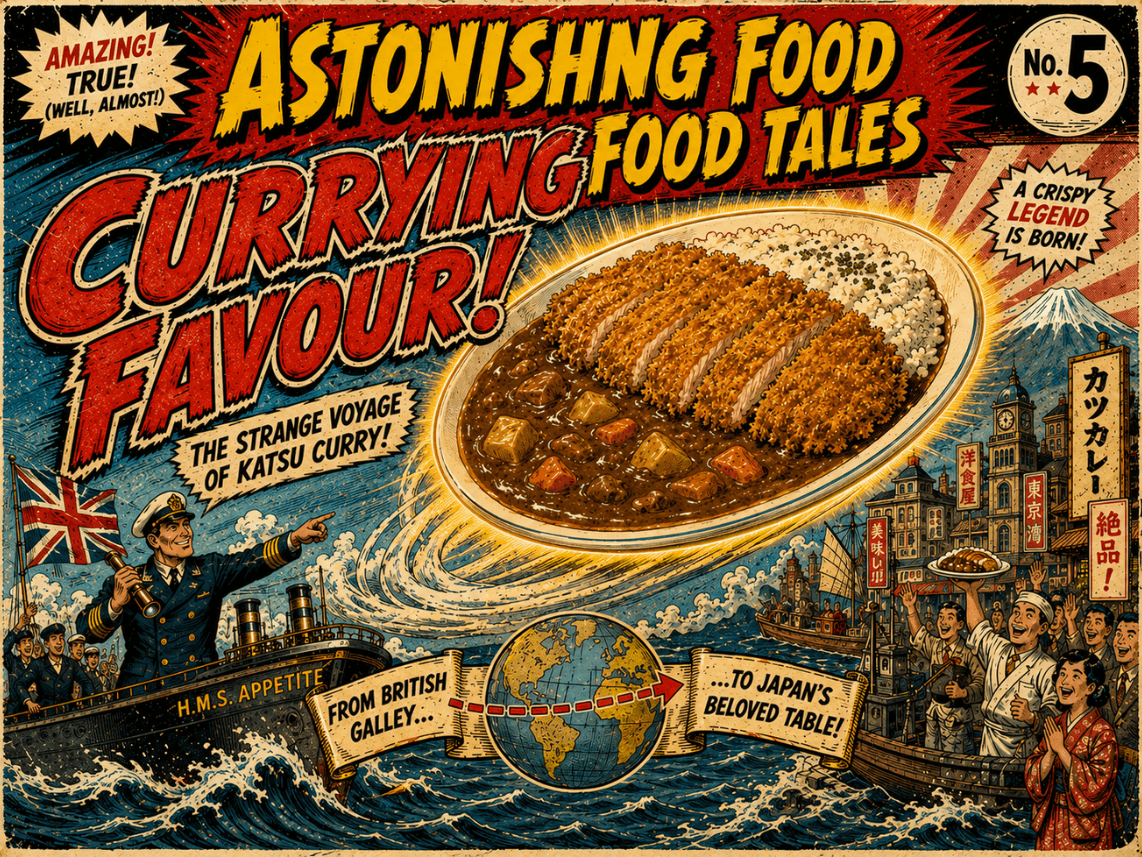
As MYA works increasingly across international markets, we’re constantly reminded how menu design has to think globally. Understanding where dishes come from, how they move, and what they mean to the people eating them can matter as much as understanding nutritional value.
Good food strategy isn’t just about ingredients or calories. It is about culture, memory, identity and expectation. That’s the purpose of Astonishing Food Tales.
Not to turn menus into history lessons. Nobody wants a footnote with their lunch.
But to reveal the journeys behind familiar dishes: the trade routes, migrations, reinventions, accidents and cultural collisions that shape what people eat, how they eat it, and what they expect from the experience. Because when you understand the story behind the food, you understand the menu more deeply. And better understanding creates better strategy.
Ask people what katsu curry is and they’ll usually say Japanese curry with a breaded cutlet. They’re right.
But only in the way a passport photo is technically a portrait.
Katsu curry looks Japanese because Japan made it Japanese. Its journey starts in India, passes through Britain, joins the Victorian Navy, sails to Japan, finds a pork cutlet, and then returns to Britain wearing a better coat and nicer shoes.
Britain took Indian curry, pushed it through empire, powdered it, simplified it, thickened it, and turned it into something useful for ships.
British naval curry was not delicate cooking. It was curry as logistics: hearty, filling, batch-cookable and robust enough to feed sailors without anyone using the word “authentic” and ruining the afternoon.
In the 1870s, Japan sent the Iwakura Mission across America and Europe to study Western systems: railways, factories, schools, military structures, naval technology and food.
Because if you are building a modern navy, you have to feed it sooner or later. Japan took British naval curry and rebuilt it. The sauce became thicker, milder and sweeter. Served with rice. Packed with onion, carrot and potato. Then came the cutlet.
Japan borrowed the European breaded cutlet through yōshoku, its own tradition of adapting Western dishes, and turned it into tonkatsu: pork coated in flour, egg and panko breadcrumbs, then fried until crisp, golden and entirely unreasonable.
Eventually, curry rice and tonkatsu met on the same plate. Katsu curry.
At MYA, we take food seriously. Not solemnly. God forbid. Seriously.
Because food is never just food. Behind every familiar dish there is usually a journey, a reinvention, a commercial opportunity and a customer expectation waiting to be understood. That’s not fusion. That’s history with breadcrumbs.
If your food and beverage offer needs sharper thinking, stronger storytelling or a better commercial strategy, talk to MYA.
We know what’s really on the plate.